


Why a good Digital Product Passport should make evidence easier to retrieve, not harder to manage
Audits are familiar territory for textile exporters.
A customer asks for a certificate.
An auditor requests a test report.
A compliance manager needs to prove a material claim.
Someone begins searching folders.
Emails.
Shared drives.
Buyer portals.
The document usually exists.
The problem is finding the right document quickly and proving that it applies to the product being reviewed.
Digital Product Passport can improve this process—but only if evidence relationships are designed properly.
A claim should always have a source
Consider a simple passport statement:
“Main fabric contains 50% recycled polyester.”
An auditor may ask:
Which supplier provided the fabric?
Which certificate supports the recycled claim?
What material does the certificate cover?
Was the certificate valid when the material was purchased?
Which production order used that fabric?
A mature DPP environment should help the company answer these questions.
Not by showing every internal document publicly.
But by preserving the evidence chain internally.
Documents alone are not enough
Many companies already have thousands of PDF certificates.
That does not necessarily mean they have organised evidence.
A document needs context.
Useful metadata includes:
document type
issuer
certificate number
facility covered
material covered
issue date
expiry date
status
related product or batch
internal owner
This turns a file into structured evidence.
Evidence should be searchable by product
Traditional filing often works in the opposite direction.
Employees search by certificate folder.
Supplier.
Year.
Audit programme.
For DPP, product-centred retrieval becomes important.
The user should be able to begin with the garment and find the supporting evidence.
This is one reason product identity is so important.
The product becomes the organising reference.

Expired evidence needs visibility
A certificate may have been valid when a product was manufactured but expired later.
This does not automatically mean the historical product was non-compliant.
The system should preserve the relevant timeline.
Current status and historical validity are different questions.
Audit-ready data should help explain both.
Do not publish confidential evidence unnecessarily
Audit readiness does not mean public-document dumping.
Consumers rarely need full laboratory reports.
Buyers may require them.
Regulators may have defined access rights.
Internal compliance teams need the full evidence set.
ESPR specifically provides role-based access to DPP data and requires data reliability and integrity.
This allows evidence to remain controlled while still supporting transparency.
 Test retrieval time
A simple readiness metric is:
How long does it take us to prove one claim?
Pick one garment.
Pick one material claim.
Ask the team to produce the relevant evidence.
If it takes two days of emails, the data relationship needs work.
If it takes two minutes, the company is moving toward real digital readiness.
Key Ideas
- Product claims should connect to identifiable supporting evidence.
• A folder full of certificates is not the same as structured evidence management.
• Evidence records need useful metadata and product relationships.
• Product-centred retrieval makes audits faster.
• Historical validity and current certificate status should be distinguished.
• Sensitive evidence can remain restricted while supporting the passport.
• Evidence retrieval time is a useful readiness metric.

Conclusion
A good DPP should not create more audit work.
It should reduce it.
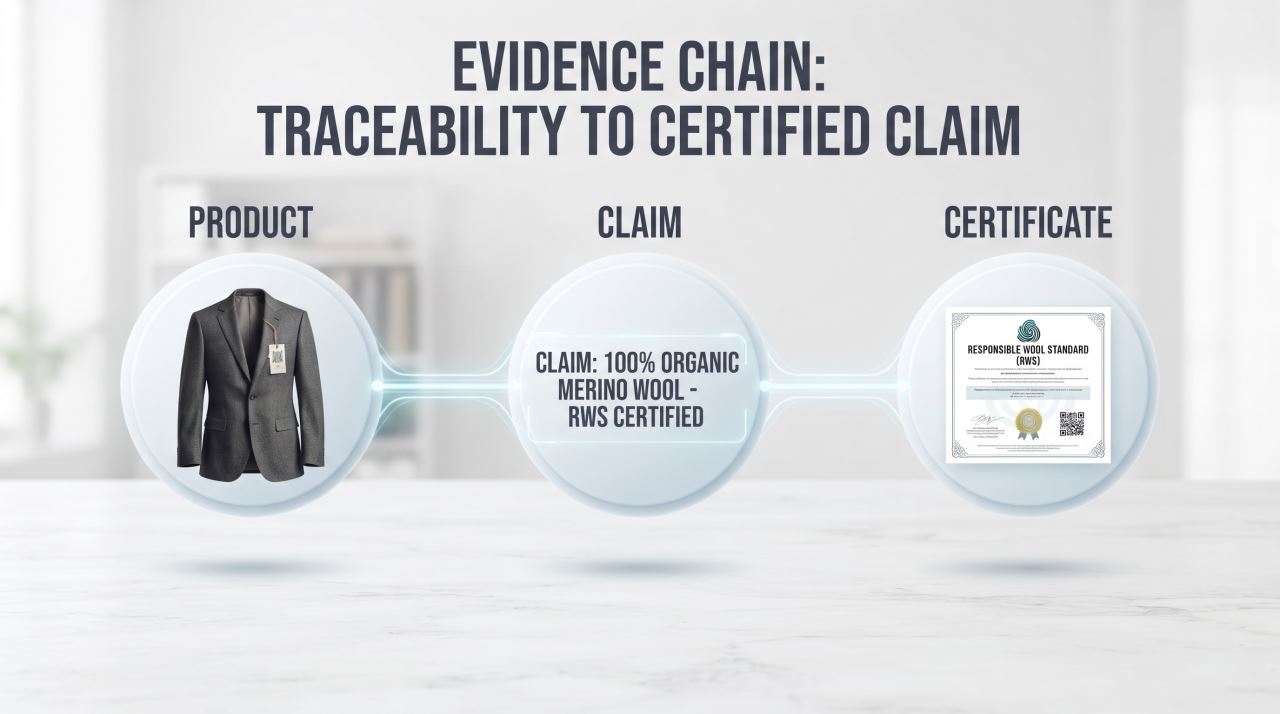
At QUIVK, we believe the strongest product passport is one where an authorized user can move logically from:
product
to claim
to evidence
without searching through dozens of disconnected systems.
That is what turns digital transparency into audit confidence.