

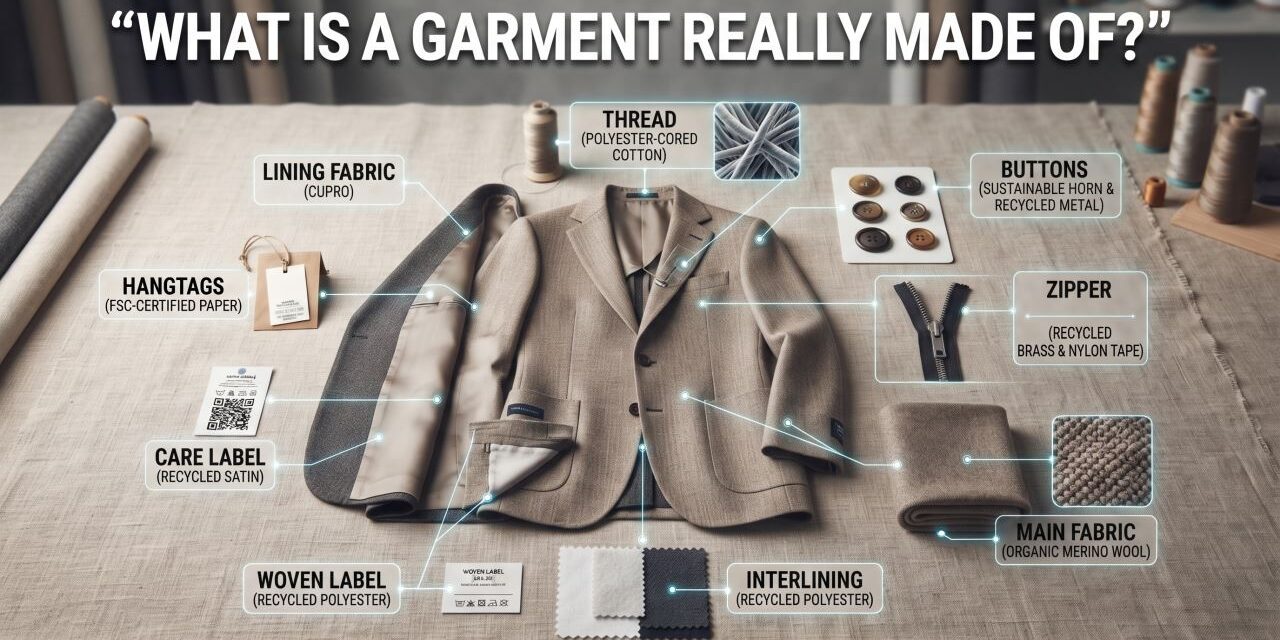
Why textile DPP requires a more complete view of materials and components
Ask a garment factory what a product is made from and the answer often comes quickly.
100% cotton.
60% cotton, 40% polyester.
95% polyester, 5% elastane.
For the main fabric, composition is usually well understood.
But a garment is rarely made from one material.
It may also contain:
sewing thread
lining
interlining
zipper tape
zipper teeth
buttons
elastic
labels
printing
coatings
embroidery thread
hook-and-loop fasteners
decorative trims
When product transparency becomes more detailed, this complexity matters.

Main-fabric composition is only the starting point
Traditional fibre labels often focus on composition as defined by applicable textile-labelling rules.
A DPP can serve a broader information purpose.
Depending on future textile-specific requirements, the product record may need to represent materials and components at greater depth.
The European Commission is still developing the textile-specific DPP framework, with the current indicative plan showing adoption of the ESPR textile delegated act in Q4 2027.
Factories should therefore avoid inventing mandatory fields today.
But they can improve their understanding of the complete product structure.
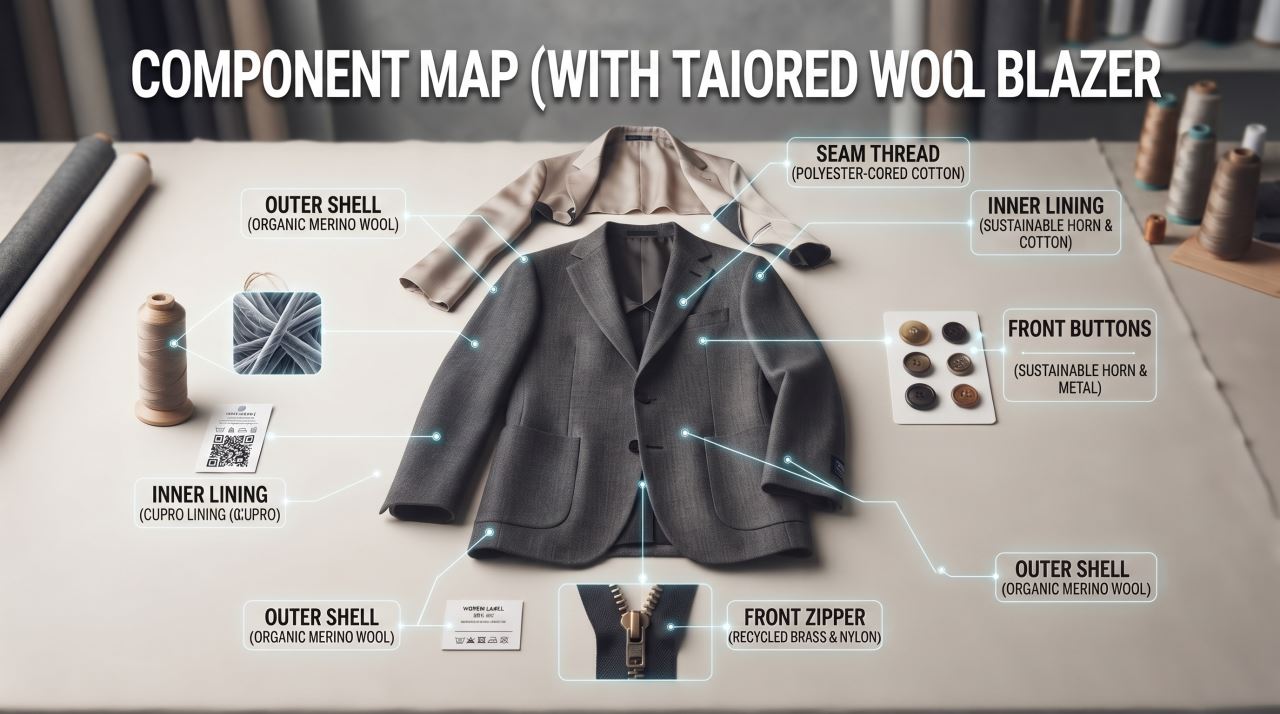
Build a product component map
Take one garment and separate it conceptually into components.
For a jacket:
shell fabric
lining
interlining
zipper
buttons
thread
label
elastic
coating
packaging
Then ask for each component:
What is it?
What is it made from?
Who supplies it?
Is the material known?
Is relevant evidence available?
Does it affect repair or recycling?
This exercise often reveals that small components have weak data.

Trims can affect circularity
A garment may have a recyclable main fabric.
But recycling can become difficult if it contains several incompatible trims.
Metal zipper.
Plastic buttons.
Elastane.
Coating.
Mixed-fibre labels.
Adhesives.
This does not mean the product is automatically non-recyclable.
It means circularity cannot always be understood from the main fabric alone.
DPP creates an opportunity to communicate a more realistic product structure.
Component hierarchy helps technology too
A good product-data model can distinguish:
product
component
material
supplier
facility
evidence
This is more flexible than placing everything in one description field.
If a zipper supplier changes, the zipper record can change without rewriting unrelated material information.
Structured component data also helps future automation.
Do not create unnecessary detail
More detail is not always better.
Recording every microscopic input creates huge operational burdens.
Factories need a practical level of granularity aligned with regulation, buyer needs and useful circularity information.
The final product-specific rules will matter.
Until then, pilot programmes should test component structures rather than assume the maximum possible level of detail.
Key Ideas
- Main-fabric composition does not describe the entire garment.
• Trims and secondary components can matter for transparency and circularity.
• Component mapping helps factories understand their products more completely.
• Structured product-component-material relationships improve digital data management.
• More detail is not automatically better.
• Final textile-specific requirements should determine mandatory granularity.
• Factories can prepare now without claiming unconfirmed fields are mandatory.
 Conclusion
Textile companies understand fabric extremely well.
DPP asks them to understand the product as a complete material system.
At QUIVK, we believe the right starting point is simple:
Take one garment.
Look beyond the main fabric.
Understand what is actually inside it.
That knowledge will support better compliance, circularity and product transparency.