
Why data-carrier placement, print quality and durability are operational decisions—not design details
When companies first experiment with Digital Product Passports, they usually generate a QR code and place it somewhere convenient.
On a hangtag.
A sticker.
A care label.
A package.
For a demonstration, almost any location may work.
For a real DPP, placement deserves much more thought.
Under ESPR, the product-specific delegated act will determine the type of data carrier, its layout and its positioning for the relevant product group.
Textile-specific details are still being developed.
Factories can nevertheless begin testing which locations work operationally.

The code should survive as long as it needs to be useful
Consider a paper hangtag.
It is easy to print.
Easy to scan.
Easy to apply.
But consumers often remove it immediately after purchase.
If the product passport is intended to remain useful for repair, resale or recycling, the hangtag may not be enough.
A sewn-in label may survive longer.
But it creates other challenges.
The material moves.
It folds.
It may wrinkle.
It is washed repeatedly.
The code must remain readable.
A permanent product code therefore needs durability appropriate to its intended lifecycle.
Print quality matters
A QR code that scans perfectly from a laptop screen may not scan equally well after being printed onto textile material.
Important factors include:
contrast
size
print resolution
quiet zone
surface texture
distortion
label curvature
washing
abrasion
Factories should test the actual production method.
Not only the digital artwork.
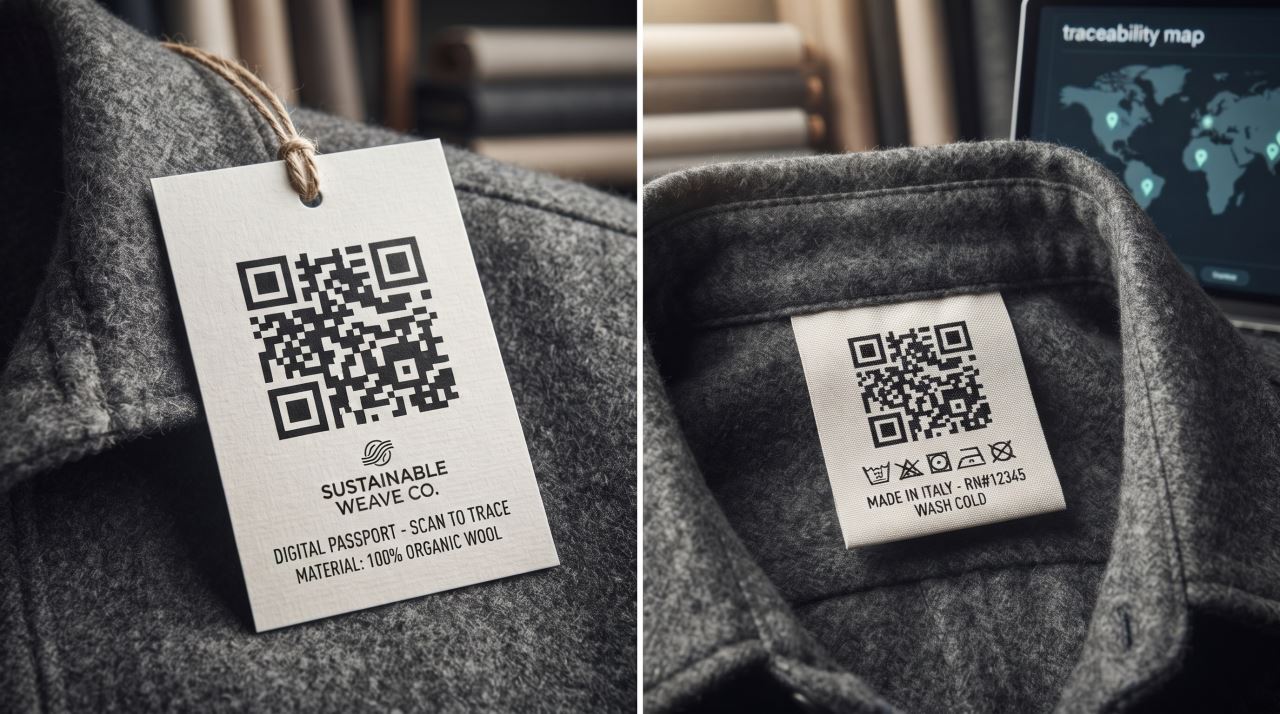
Placement affects the user experience
A code hidden deep inside a garment may survive for years.
But if consumers cannot find it, usage will be low.
A large visible code may scan easily but conflict with product aesthetics.
The correct location needs to balance:
accessibility
durability
comfort
design
production practicality
regulatory positioning requirements
Different product categories may need different approaches.
A jacket, shoe, towel and T-shirt do not have identical labelling environments.
Packaging can play a supporting role
ESPR allows the applicable delegated act to specify whether the data carrier appears on the product, packaging or accompanying documentation.
This does not mean exporters should decide today that packaging is sufficient for textiles.
But it does mean DPP architecture needs to consider the complete physical product experience.
In some use cases, an easily accessible packaging code may support pre-purchase access while a more durable product carrier supports lifecycle access.
Online sales matter too
DPP is not only about scanning a physical product in a store.
ESPR provides for relevant product-passport access before customers are bound by a distance-sale contract when specified through the applicable product requirements.
That means brands and retailers may also need a digital representation of the product identifier online.
Factories should therefore think beyond printing.
The same product identity may need to function:
on the product
in packaging
in buyer systems
on e-commerce pages

Run real physical tests
A useful factory test should include:
printing the actual code
applying it using the planned production process
scanning several devices
checking low light
checking folds
checking different angles
washing the garment repeatedly where relevant
checking abrasion
testing after normal wear
This provides much better evidence than simply confirming that the QR file is technically valid.
 Key Ideas
- The textile-specific delegated act will ultimately define permitted data-carrier and positioning requirements.
• A temporary hangtag and a lifecycle product carrier solve different problems.
• Print quality can change significantly when a QR code moves from a screen to textile material.
• Placement should balance accessibility, durability, comfort and design.
• Online sales create another product-access requirement.
• Factories should physically test codes under realistic use conditions.
Conclusion
The QR code may be technically simple.
Its physical implementation is not.
At QUIVK, we believe textile exporters should treat data-carrier testing like any other production-quality exercise.
Print it.
Apply it.
Wash it.
Use it.
Scan it again.
The passport is only useful if people can still reach it.