

Why chemical information needs context, evidence and controlled access
Chemical compliance is already a major part of textile manufacturing.
Factories manage buyer restricted-substance lists.
Chemical inventories.
Safety documentation.
Supplier declarations.
Laboratory testing.
Process controls.
Certification programs.
When Digital Product Passports become more widely used, some chemical and substance-related information may also become part of the product information environment, depending on applicable requirements.
This creates both an opportunity and a challenge.
The opportunity is better transparency.
The challenge is avoiding oversimplification.
Not all chemical evidence means the same thing
Consider a finished garment that passes a laboratory test.
That tells us something important about the tested sample.
It does not necessarily describe every chemical used during manufacturing.
Now consider a chemical supplier declaration.
That tells us something about the supplied chemical.
It does not automatically prove the final garment result.
A factory may also have process-level certification.
Again, that provides another type of evidence.
These records should not be treated as interchangeable.
A strong DPP data model preserves the context.
Product testing needs clear scope
Laboratory reports should be connected to:
the tested product
material
colour where relevant
batch or production reference where applicable
test method
laboratory
test date
A report for one black fabric should not automatically be treated as evidence for every color and material used by the company.
Product relationships matter.

Process information may be commercially sensitive
Factories can hold highly detailed chemical information.
Recipes.
Formulations.
Supplier information.
Processing conditions.
Not all of this should necessarily become public.
ESPR provides for role-based access to passport information, with specific access rights to be defined for product groups.
That makes access design important.
Consumers may need high-level information.
Buyers may require more detailed compliance evidence.
Authorities may require another level of access.
Internal technical teams may need the most detailed information.
A DPP should support transparency without exposing unnecessary trade secrets.
Keep chemical documents current
Chemical compliance information changes.
Buyer RSLs are updated.
Certificates expire.
Chemical suppliers reformulate products.
Laboratory reports become outdated.
Product materials change.
The DPP should therefore not operate like a static document archive.
Factories need a process to review information periodically.
Expiry alerts and approval workflows become useful.
Connect chemical data to sourcing
Chemical compliance is not only the responsibility of the wet-processing factory.
Material sourcing decisions influence risk.
A trim can fail chemical requirements.
Printing inks matter.
Coatings matter.
Accessories matter.
Packaging can have its own compliance requirements.
A product-level approach encourages factories to see chemical compliance across the whole product structure.
Avoid making the passport too technical
Consumers do not need to read a laboratory report with dozens of chemical parameters.
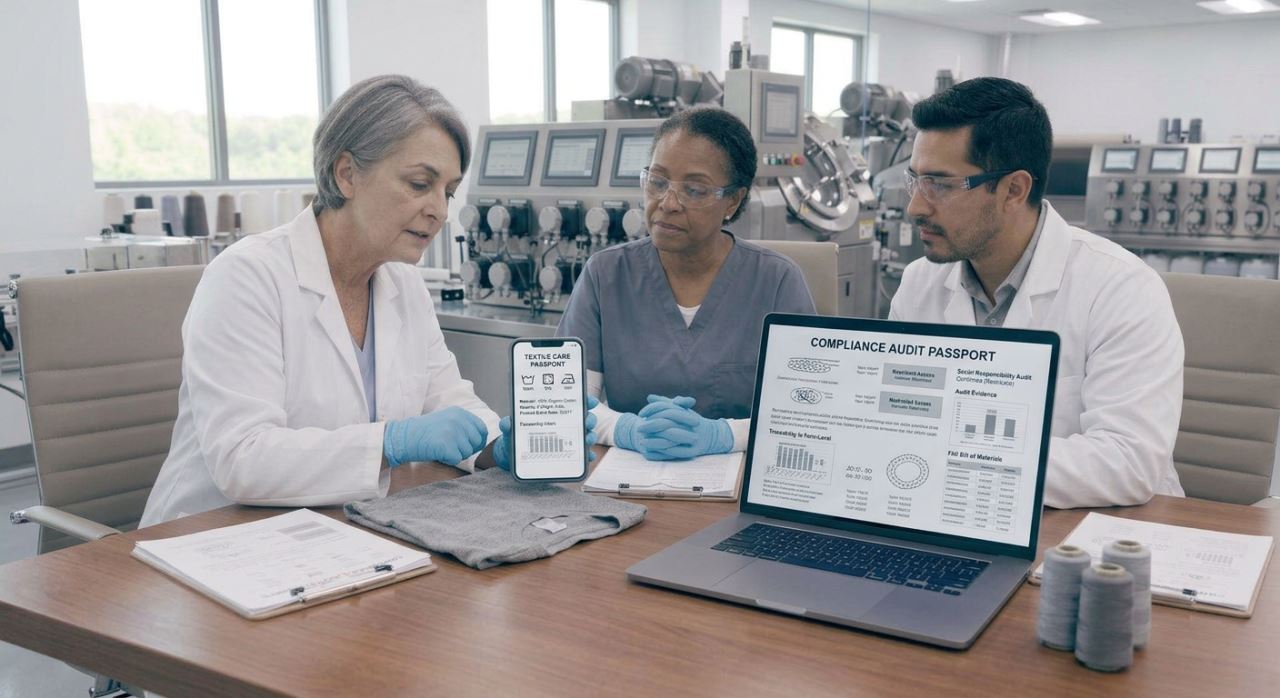
The DPP interface should translate technical evidence into information appropriate for the user.
For example, the public view might state that the product has been tested against a defined program.
An authorised buyer view could provide the report.
The full internal system can retain the detailed technical evidence.
Good DPP design is not about showing everyone everything.
It is about giving each user the information they legitimately need.
 Key Ideas
- Final-product tests, chemical supplier data and process controls provide different types of evidence.
• Laboratory reports should be linked to their actual product and test scope.
• Sensitive process information does not necessarily need to be public.
• Chemical compliance information needs ongoing review and update.
• Trims, printing, coatings and other components should also be considered.
• DPP interfaces should present technical information appropriately for each user.
Conclusion
Chemical compliance is a good example of why DPP is more than a document-upload project.
The data needs context.
The evidence needs scope.
Access needs control.
Updates need ownership.
At QUIVK, we believe a useful textile passport should make chemical compliance easier to understand without pretending that complex technical evidence is simple.
Good transparency preserves accuracy.






