


Why exporters need to connect sustainability information to specific products
Textile companies have become much better at communicating sustainability.
Annual reports discuss energy reduction.
Websites talk about responsible sourcing.
Factories display environmental certifications.
Buyers receive sustainability questionnaires.
All of this is valuable.
But a Digital Product Passport introduces a more specific question:
What is true about this particular product?
That difference between company-level sustainability and product-level evidence may become one of the most important changes for exporters.
A factory claim is not automatically a product claim
Imagine a garment factory uses renewable electricity at its facility.
That is useful company or facility information.
But it does not automatically tell us the environmental impact of one specific garment.
Likewise, a supplier may hold a certification.
That does not automatically prove every material supplied by that company is certified.
A factory may use recycled polyester.
That does not mean every polyester garment contains recycled material.
Product-level information requires a clear connection between the claim and the product.
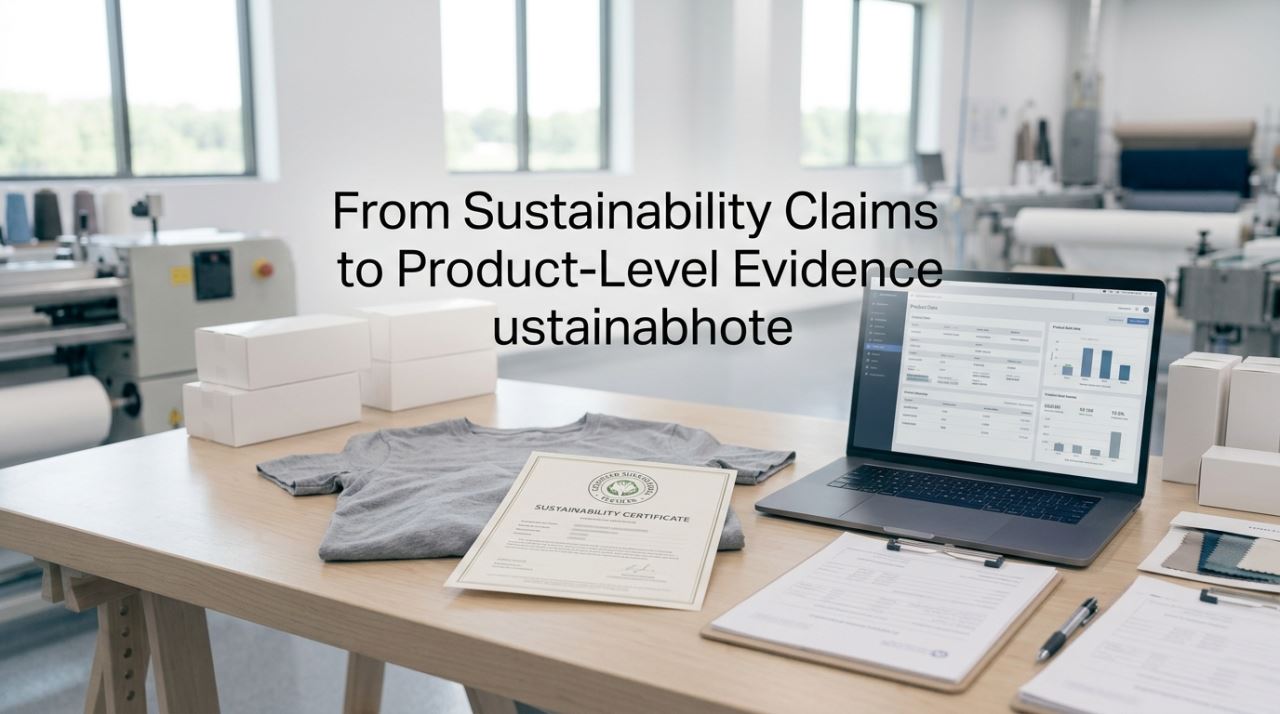
Start with precise language
Broad sustainability language creates risk.
Words such as:
green
eco-friendly
responsible
sustainable
recyclable
can mean many things.
A stronger product statement is specific.
For example:
“Main fabric contains 40% recycled polyester.”
That statement can be checked.
The organisation can then ask:
Which fabric?
Which supplier?
Which evidence?
Which production batch?
Who verified it?
Specific claims are easier to govern.

Evidence should match the claim
Every important sustainability claim should have a supporting evidence path.
The evidence may include:
certificate
transaction record
supplier declaration
laboratory result
calculation
lifecycle assessment
verified primary data
The correct type of evidence depends on the claim.
The DPP platform should not simply become a place to publish attractive statements.
It should help the organisation control which information has been reviewed and approved.
Measured, calculated and supplier-reported data are different
Environmental information may come from several sources.
Some information is measured directly.
Some is calculated.
Some is estimated.
Some comes from suppliers.
Some comes from industry databases.
These categories should not be treated as identical.
A mature data system records the source and method.
If one product footprint is calculated using one method and another using a different boundary, the numbers may not be directly comparable.
Transparency includes explaining where the number came from.

Chemical compliance also needs product context
Chemical information creates similar challenges.
A factory may have:
chemical inventory records
supplier declarations
restricted-substance documentation
final-product laboratory tests
process certifications
These pieces provide different types of evidence.
A final garment test does not necessarily describe every chemical used in production.
A chemical supplier declaration does not necessarily prove the final product result.
A good DPP data model should preserve these distinctions.
Build a claim-approval workflow
Before information becomes visible in a passport, factories should define approval.
For every important product claim:
Who prepares it?
Who checks the evidence?
Who approves it?
When should it expire?
What happens when evidence changes?
Who can correct the passport?
This is especially important for consumer-facing information.
Once a statement is published publicly, it may influence purchasing decisions and brand trust.
Product-level evidence can become a commercial strength
Better sustainability evidence is not only about compliance.
It can improve buyer confidence.
When two suppliers make similar claims, the supplier that can provide organised, product-specific evidence may be easier to work with.
Questions can be answered faster.
Buyer onboarding becomes easier.
Audits become less disruptive.
Claims are easier to defend.
This turns good data management into commercial capability.

Key Ideas
- Company sustainability information and product sustainability information are different.
• Product claims should be precise rather than vague.
• Claims should be connected to relevant evidence.
• Measured, calculated, estimated and supplier-reported data should be distinguished.
• Chemical compliance evidence also needs clear product context.
• Factories need approval workflows before claims are published.
• Strong product-level evidence can improve buyer trust.
Conclusion
The Digital Product Passport will not make sustainability claims more credible simply because they are digital.
Credibility still comes from evidence.
The opportunity for exporters is to improve the link between what the company says and what the product can prove.
At QUIVK, we believe a useful passport should be conservative with claims and strong with evidence.
Fewer unsupported statements.
More precise information.
Clearer product relationships.
That is how digital transparency becomes trustworthy.






